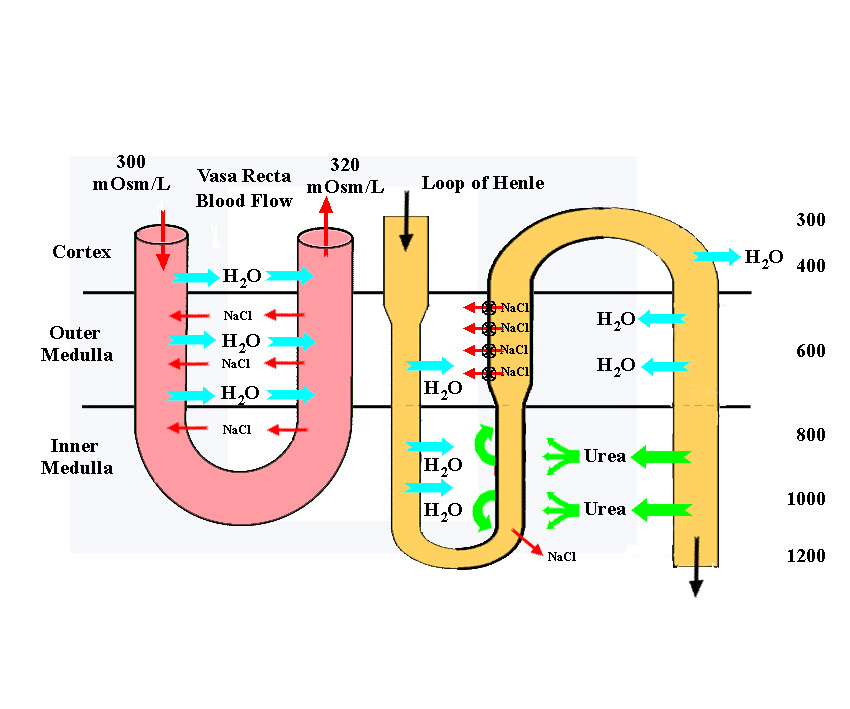
| The Role of the Vasa Recta in achieving Hyperosmolality of the Medullary Interstitium |
Under normal conditions of blood flow, the osmolality gradient that would be produced in the medullary interstitium, would rapidly disappear as the solutes are carried away by the blood flow. This does not occur as the medullary blood flow has two important mechanisms that inhibit this.
| 1. | The medullary blood flow is very sluggish and minimal in amount (2% of total renal blood flow). Because of this, the removal of solutes is very minimal. |
| 2. | The Vasa recta act as a countercurrent exchanger. |
The walls of the vasa recta are highly permeable to both water and solutes and at the same time, the two limbs are in close proximity. As blood flows down the descending limbs of the vasa recta, sodium ions, chloride ions and also urea, diffuse into the blood stream from the interstitium, down their concentration gradient. On the other hand, water diffuses out of the descending limb. In the ascending limb of the vasa recta, the opposite occurs, sodium ions, chloride ions and urea diffuse out of the blood and water diffuses in.
Thus at the outlet, the osmolality is only slightly increased (320mOsm/l) as compared to the inlet (300mOsm/L). Thus minimal washout of solutes occurs.
|
|
